
Speak with confidence abroad: Using AI to prep for your next trip
What's the most intimidating part of traveling somewhere you don’t speak the language fluently? When we posed that question to the AILC community, the overwhelming response was… (Can you guess it?)
Ordering food.
Close behind: Getting lost.
Makes sense. Knowing what dishes to try abroad is easy – ordering them and understanding what the waiter says back is where it gets complicated. Same with getting around: Google Maps can get you most of the way, but if your phone dies, you'll need to ask a real person for directions – and understand what they tell you back.
Meet Your New Travel Coach
That's where AI comes in – and the best part is that getting ready for your trip can double as language practice. Do your research in your target language, and you’re picking up vocabulary and reading comprehension before you’ve even left home.
The key is to think of AI less as a search engine and more as a coach. And it’s not just about planning your trip, it’s about readying yourself, too. You can use it to rehearse the real situations you’ll actually be in – ordering food, making small talk, asking if a dish is vegetarian – and get a sense of how the conversation might go. By the time you land, you’ve already got a personalized itinerary and the phrases that’ll come in handy.
Once you’re there, that same coach is still in your pocket – ready to help you get around, translate signs and menus, and wander a bit further than you might have otherwise.
The Travel Confidence Challenge
We recently put all of this into practice with a five-day Travel Confidence Challenge.
Here are some of the missions we gave our community:
Get AI to plan your entire trip
AI can be the ideal travel planner, helping you map out an itinerary, dig into useful vocab, and explore local customs.
One member, learning French at a C2 level, used AI to plan around a very specific question: could they go kitesurfing on an upcoming trip to Thailand? AI walked them through which beaches were good for it and which season was best.
Learn the do's and don'ts of a place
Customs change everywhere you go – and getting them right is one of the easiest ways to make a good impression abroad.
One member used the challenge to prep for an upcoming trip to Thailand. A couple of things stood out: address people using the title “Khun” followed by their first name, and skip the tip at street food stalls – it's not expected there.
Rehearse the conversations you'll have ahead of time
Knowing the words is only half the job – you also need to know how to use them, and what to expect when someone answers. Instead of a flashcard deck, you can ask AI to walk you through a specific scenario and have it prepare you for the kind of reply you’re likely to get back.
We ran a live open practice session built around this exact idea, using a member's upcoming trip to Slovenia. We worked through travel phrases, practiced language for getting around, and talked through safety and tipping etiquette.
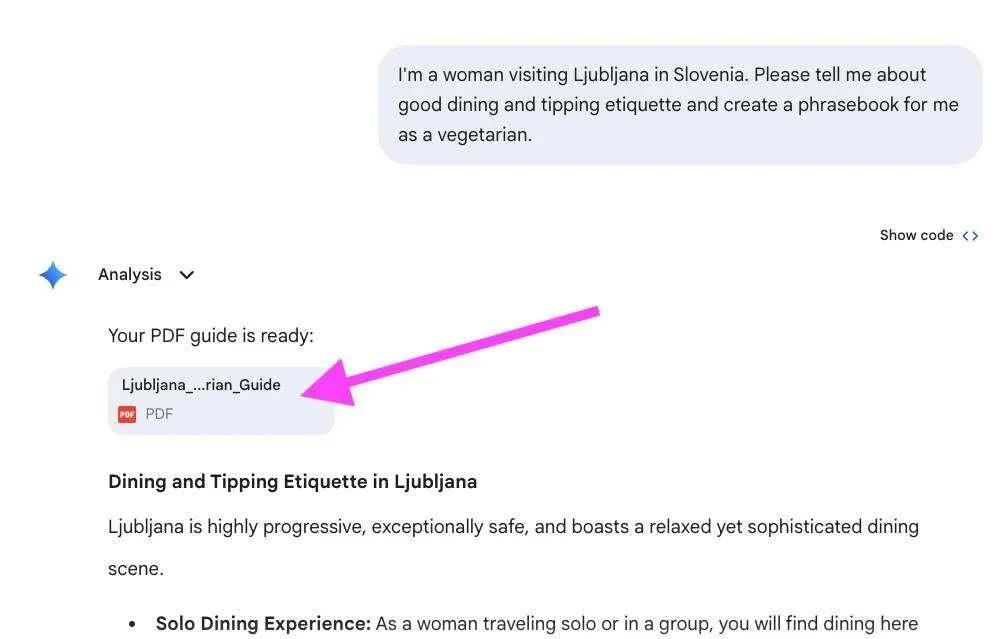
A chat with Gemini about dining and tipping etiquette in Slovenia.
Gemini put together an etiquette guide with sections on dining customs, solo travel safety, when to tip and when not to, plus a custom phrasebook for eating as a vegetarian. It packaged all of it into a PDF that the member could pack along for the trip and study on the plane.
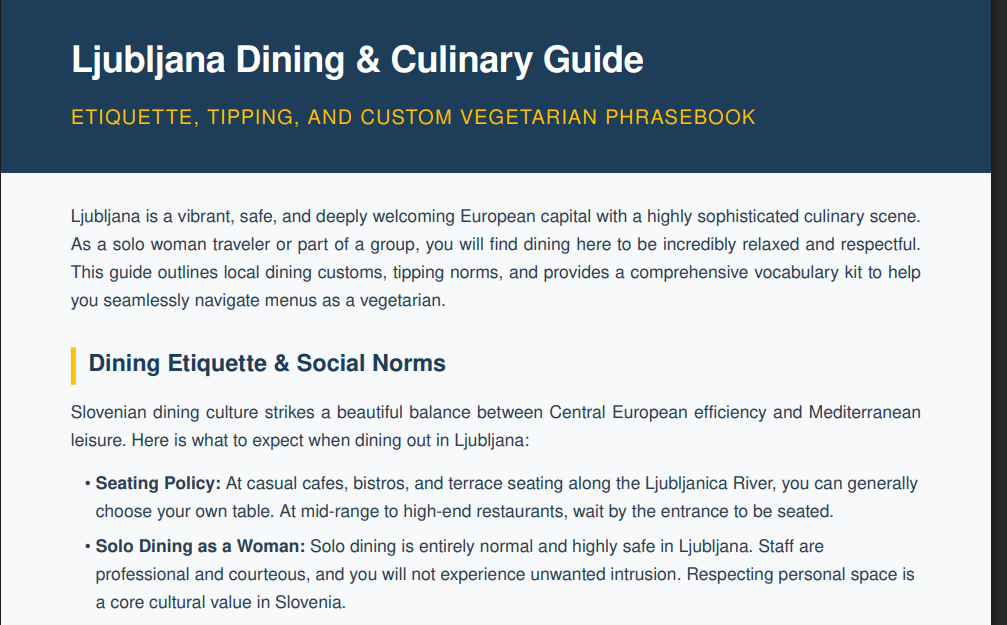
Gemini guide to dining, tipping, and vegetarian phrases in Ljubljana.
Decode signage and menus on the fly
No phrasebook covers everything. Menus, handwritten notices, and local signage will always throw something at you that you've never seen, whether you’re still learning the language or don’t speak a word of it. Point your phone’s camera at them, and AI can give you a quick translation on the spot – no dictionary, no guesswork.
It can do even more than translate, too.
In the video tutorial for this mission, Josh shows this with a real-life menu his parents sent him while out in Barcelona, asking ChatGPT not just to translate it, but to explain each dish and answer follow-up questions – like what to order if you’re on a low-sodium diet, which happens to be his mom’s situation.
Try preparing for your trip with AI
Here’s the gist of it: open up your favorite AI chatbot and ask it to act as your travel planner. Give it your destination, your dates, and what you’re interested in, and see what it comes back with. Then dig deeper – ask about local etiquette, get it to generate a few useful phrases for situations you’ll likely run into, or have it rehearse a conversation with you before you go
Want the full experience? You’ll find the entire 5-day challenge – plus a library full of ideas on how to use AI for language learning – insideAI Language Club, for just $9 a month.